
Mount Pleasant City Directory Collections
Mount Pleasant does not appear as one continuous, town-named run. The useful shelf is a group of White Plains-area and railroad-corridor publications that include Valhalla, Hawthorne, and nearby places. The FamilySearch catalog records reel and item placement, not a confirmed individual page. Use the catalog to locate a volume, then examine the reel before copying any name or address. The earlier Trow material is selective, so an absent name is not a finding that the person was absent from the area.
| Collection | Years | Where Held | Access |
|---|---|---|---|
| Turner’s annual directory, White Plains area | 1905; 1907 | FamilySearch film 2309609, items 3 and 5; 1905 DGS 8665369 | FamilySearch Library microfilm |
| Turner’s Harlem Railroad directory | 1904–1905 | FamilySearch film 2309610, item 3, DGS 9180764 | FamilySearch Library microfilm |
| Richmond’s White Plains-area directories | 1913; 1915; 1916–1917 | FamilySearch film 2309610, items 2, 4, and 5 | FamilySearch Library microfilm |
| Trow metropolitan selected-name directory | 1885–1893 | New York Public Library microform, with reels for 1886–1889 and 1889–1893 | Selected names and suburban towns only |
These verified dates are targets, not proof of a complete annual series. The research did not locate the locality’s first or last printed directory year. Keep the publisher, year, reel, item, and printed place with every note, especially when a family moved between a hamlet and a neighboring postal community.
Mount Pleasant Directory Place Names
A historical Mount Pleasant directory search should use the publisher’s geography. Valhalla, Hawthorne, Pleasantville, Thornwood, Tarrytown or Sleepy Hollow, Briarcliff Manor, and White Plains may be the more productive headings for a Town family. Railroad towns are especially important in the Turner and Richmond titles. Search the surname, initials, spouse or widow notation, street, business name, and each plausible locality. A result should retain its printed place name rather than being silently converted to a modern municipal label.
That approach also prevents a false match. A name in a White Plains directory may identify a person connected with White Plains, not necessarily a Town resident. A street line, dated newspaper item, deed, census record, or obituary from the same period provides the second source needed to evaluate the connection.
Note: Postal labels, village boundaries, and Town geography can differ, so record each one exactly as the source gives it.
Mount Pleasant Library Directory Access
The Mount Pleasant Public Library local-history collection is the practical starting desk for a historical city directory question. Its Main Library is at 350 Bedford Road, Pleasantville, and its published local-history hours are Monday through Thursday, 10 a.m. to 8 p.m., and Friday through Saturday, 10 a.m. to 5 p.m. The collection includes genealogies, obituary indexes, local newspapers, maps, photographs, postcards, and subject files for the Town and nearby communities. Ancestry Library Edition is available on public computers and on a visitor’s own device while at the library.
The library’s local-history collection is the source for this view of the access point.
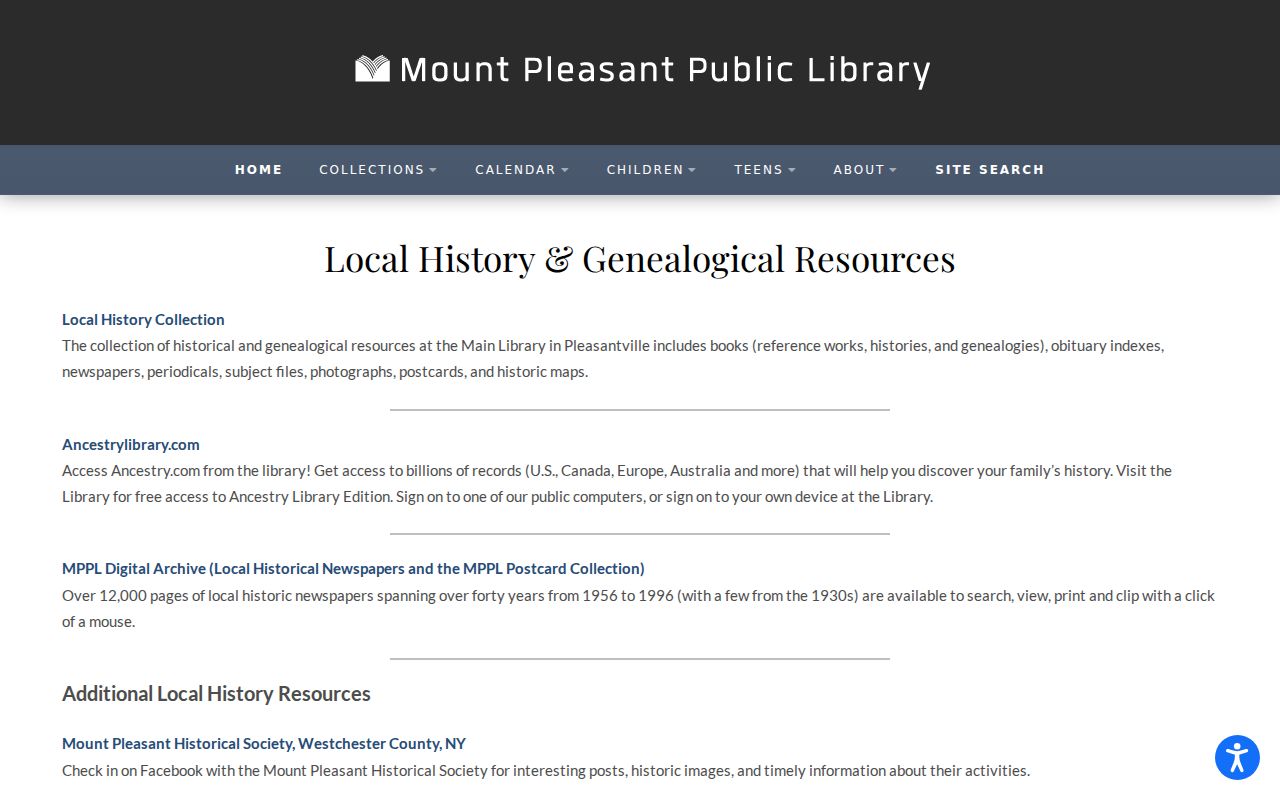
Those library holdings provide a useful bridge when a directory reel gives only a name, an address, or a place label.
For a deeper county context, the Westchester County Historical Society collections include family, biography, cemetery, photograph, and finding-aid material. Its research service and reading-room rules are separate from the library. The available research does not establish that either repository holds a complete city-directory or private membership list, so call before making a special trip for a particular year.
Mount Pleasant Archive OCR Checks
Digitized newspapers can add the context a city directory omits. The Mount Pleasant digital archive has more than 12,000 pages, including the Valhalla Voice from 1901 to 1980, with 5,091 listed pages. Other named runs include the Pleasantville Journal, Pleasantville Post, Saw Mill River Record, The Chronicle, and Pleasantville Chronicle. Search a surname, street, business, organization, or hamlet, then save the issue date and page.
OCR is a finding tool, not a transcription. Compare every promising result with the scanned page image because names, initials, and street text can be misread. A newspaper notice may support a dated household or local activity, but it is not a replacement for viewing the directory reel itself.
Note: Preserve the page image with the search term when an OCR result supplies the only lead.
Reading Mount Pleasant City Directory Entries
The FamilySearch record is reel-level, so no sample person, page, typeface, or symbol should be invented from its catalog entry. Once a specific volume is viewed, make an inventory of what that page actually prints. Common directory structures can include a surname and given name or initials, occupation or business, spouse or widow notation, street and house number, town or postal place, and nearby classified or street-index context. Treat each item as a dated publisher statement, not as a current profile.
| Identity line | Copy the surname, given name, initials, and any spelling variant exactly as printed. |
|---|---|
| Occupation or business | Record it only when the viewed volume contains it; it can separate same-name people. |
| Household notation | Preserve spouse, widow, boarding, or other relationship wording without expanding it. |
| Address and place | Keep the house number, street, and printed locality together. |
| Property-status mark | Copy any ownership or boarding notation only if the volume displays one. |
- Criss-cross directory
- A later directory section arranged by street and address rather than alphabetically by name. The available research did not verify a Mount Pleasant run.
- Householder index
- An index that groups a household under the named householder. Check the volume’s own title and arrangement before assuming it has one.
- Abbreviation key
- The volume’s explanation of shortened labels. Record the key’s page before interpreting an abbreviation in an entry.
Mount Pleasant Directory Timeline
The verified city directory record is a set of dated stops, not a continuous sequence. A timeline keeps the source trail honest and makes gaps visible. It also shows when a newspaper or census may be the better companion source.
| 1885–1893 | Trow’s metropolitan directory covers selected names and suburban towns; the NYPL microform reels do not prove complete local coverage. |
|---|---|
| 1904–1905 | Turner’s Harlem Railroad title provides the railroad-corridor directory target on FamilySearch film 2309610, item 3. |
| 1905 and 1907 | Turner’s White Plains-area annual directories appear on film 2309609, items 3 and 5. |
| 1913–1917 | Richmond’s documented 1913, 1915, and 1916–1917 runs are on film 2309610. |
| 1901–1999 | Local digital newspaper runs extend the historical search beyond the verified directory dates, with gaps by title. |
Mount Pleasant was formed in 1788, but that date is not a city-directory starting date. Early local evidence can instead appear in Town record-book material, County deed and estate indexes, maps, church records, or newspapers.
Mount Pleasant City Directory Gaps
A missing name has several ordinary explanations. The volume may cover selected names, use a spouse’s or business name, file a household under a nearby place, omit a street section, or simply fall between surviving years. Street and address directories were uncommon before the late 1920s, according to New York Public Library directory-history guidance. Older volumes may be strongest in alphabetical or business sections rather than a reverse street format.
Use the missing year as a prompt for a second source. The library’s obituary indexes and newspapers, county probate and naturalization indexes, historic maps, deeds, and public census schedules can all supply a different date or relationship. For a modern parcel or address question, use the resident lookup route instead of extending a historical entry into the present.
Tracing Mount Pleasant City Directories
A careful household trail moves forward through the documented years and labels each result by date and locality. Census schedules currently available through 1950 can supply household, relationship, and address context near a directory year. Deeds, maps, obituaries, probate material, and the local newspaper archive are useful checks when an entry disappears, a surname changes form, or an address does not fit the later map.
- Choose the earliest verified directory year and search the publisher’s place name as well as the surname.
- Record the reel, item, page, printed locality, address, and every original spelling before moving to another year.
- Follow the name through the next documented Turner or Richmond run, keeping a move, widow notation, or business reference as a lead rather than a conclusion.
- Pair a directory date with the nearest available census, then compare a local newspaper notice, deed, map, obituary, or probate index from the same period.
- When a name vanishes, test a locality change, initials, spouse notation, death, or an unlisted household before deciding that the trail ends.
A directory entry can be excellent historical evidence when it is read at its own date. It cannot independently establish a present address, an exact relationship, or a complete household. The strongest result keeps both sources and their differences in the research notes.
Note: Use census enumeration dates and Town or village boundaries when comparing two records from the same decade.
Westchester Herald Record Loss
The Library of Congress describes the Westchester Herald as a weekly Mount Pleasant and Village of Sing Sing newspaper published from 1834 to 1857. Its office was destroyed by fire on December 6, 1856. That documented loss is a practical reminder that a broken newspaper run does not prove a family event never happened. It tells the researcher to check surviving issues, County records, maps, and other repositories before drawing a conclusion from silence.
The Herald belongs beside, rather than inside, the city directory shelf. It may provide a name or place at an earlier date, while the reel-based directories provide their own later and limited coverage.